Methodology
This page lists every formula and constant used across Pavetally. If a calculator on this site gives you a number, the arithmetic behind it is on this page — including where each assumption comes from and how much it can reasonably vary.
The constants
| Constant | Value used | Range / basis |
|---|---|---|
| Hot-mix asphalt density (in place) | 145 lb/ft³ | Asphalt Institute: typically 142–148 lb/ft³ in place, 148 recommended for estimating. Editable in every calculator. |
| Pounds per US short ton | 2,000 lb | Definition. Metric results convert at 1 short ton = 0.907185 tonnes. |
| Cubic feet per cubic yard | 27 ft³ | Definition. |
| Waste allowance | 5% (optional) | Working allowance for edge loss, uneven base and cooled material. A checkbox, not a hidden markup. |
| Asphalt millings conversion | 1.4 tons/yd³ | Supplier charts commonly list 1.2–1.6 t/yd³; Gravelshop publishes 1.21 t/yd³ (2,410 lb/yd³). Editable. |
| Millings compaction allowance | 15% extra volume (optional) | Working allowance for volume lost when millings are rolled. A checkbox. |
Asphalt tonnage
Show your math
Area × depth gives volume; volume × density gives weight. Depth is divided by 12 because it is entered in inches while length and width are in feet.
Depth should be the compacted (finished) thickness, not the loose thickness laid by the paver.
Source: Asphalt Institute — pavement thickness and mix design FAQs
volume (ft³) = L (ft) × W (ft) × D (in) ÷ 12
tons = volume (ft³) × density ÷ 2,000
tons ordered = tons × (1 + waste)
At the default 145 lb/ft³ this reduces to tons ≈ L × W × D × 0.006042.
Coverage per ton
Show your math
This is the tonnage formula rearranged. It answers the supplier's version of the question — "how far will a ton go?" — rather than the homeowner's.
Many supplier charts round the 2-inch figure down to 80 ft² per ton, which builds in a small safety margin.
coverage (ft² per ton) = 2,000 ÷ (density × depth (in) ÷ 12) At 145 lb/ft³: 83 ft² at 2 in, 55 ft² at 3 in, 41 ft² at 4 in.
Material cost
Show your math
Material cost is exact arithmetic on numbers you supply. We deliberately do not calculate an installed price from a formula.
Installed cost ranges on the cost guide come from published 2026 industry cost data and are presented as ranges with their source named.
material = tons × price per ton
delivery = tons × delivery per ton
total = material + delivery
Installed cost is a published $/ft² range, not a calculation — labour and site work vary far more than material.
Asphalt millings
Show your math
Millings run on a tons-per-cubic-yard conversion rather than a lb/ft³ density, because that is how suppliers quote them and because grind size and settling change the weight per yard.
This is the least precise calculation on the site, and we say so on the calculator page. Ask your supplier for their conversion and enter it.
Source: Gravelshop — asphalt millings conversion (1.21 t/yd³)
yd³ = L (ft) × W (ft) × D (in) ÷ 324
yd³ ordered = yd³ × (1 + compaction)
tons = yd³ ordered × tons per yd³
Default: 1.4 t/yd³ with a 15% compaction allowance.
Where these calculations stop being useful
- They assume a uniform depth. Real sites are not perfectly level, and a driveway built to shed water is thicker in places.
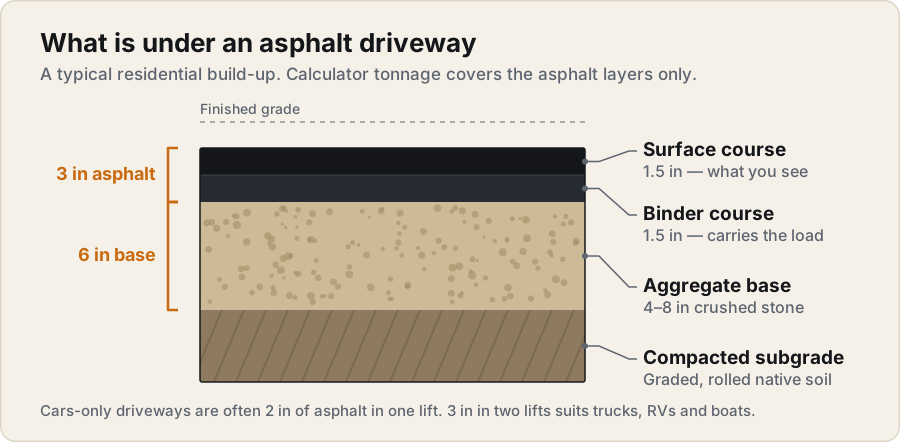
- They cover asphalt only. The aggregate base underneath is a separate material with its own density and is not included in any result.
- They do not know your mix. Binder course and surface course differ slightly in unit weight; a supplier's figure always beats ours.
- They are not an engineering design. Required thickness depends on soil, frost depth, drainage and expected loads.
How this page is maintained
The constants above live in a single file in the site's source code. The calculators, the tables inside the guides and this page all read from it, so a change happens everywhere at once. When a source publishes updated figures, the constant and the "last updated" date change together.
Frequently asked questions
What density does Pavetally use for asphalt?
145 pounds per cubic foot (2,323 kg/m³) for hot-mix asphalt in place. The Asphalt Institute states that asphalt mixture typically weighs 142 to 148 pounds per cubic foot in place and recommends using 148 for estimating; 145 is the middle of that published range. Every calculator lets you change it.
Why do results differ from another asphalt calculator?
Almost always because of density or waste. Some calculators assume 2.025 tons per cubic yard (150 lb/ft³), some use 2.0 tons per cubic yard flat, and some silently add a waste allowance. Pavetally uses 145 lb/ft³, shows it on the page, and makes the 5% waste allowance a checkbox you control.
Are the tables on the guide pages calculated or typed in?
Calculated. Every tonnage and coverage table on this site is generated at build time from the same functions the calculators run in your browser, so a change to a constant updates the tool and the tables together. No figure in a table is entered by hand.
Do the calculators send my measurements anywhere?
No. All calculations run in your browser using client-side JavaScript. Nothing you type into a calculator is transmitted to a server, stored, or logged.