How much asphalt do I need?
A typical two-car driveway (20 × 20 ft, 400 ft²) needs about 4.8 tons of asphalt at 2 inches deep or 7.3 tons at 3 inches. As a rule of thumb, one ton covers about 83 square feet at 2 inches. Multiply by your own area below.
The honest answer is that it depends on two numbers you control — area and depth — and one you mostly do not: the density of the mix. Fix the first two and the tonnage falls out.
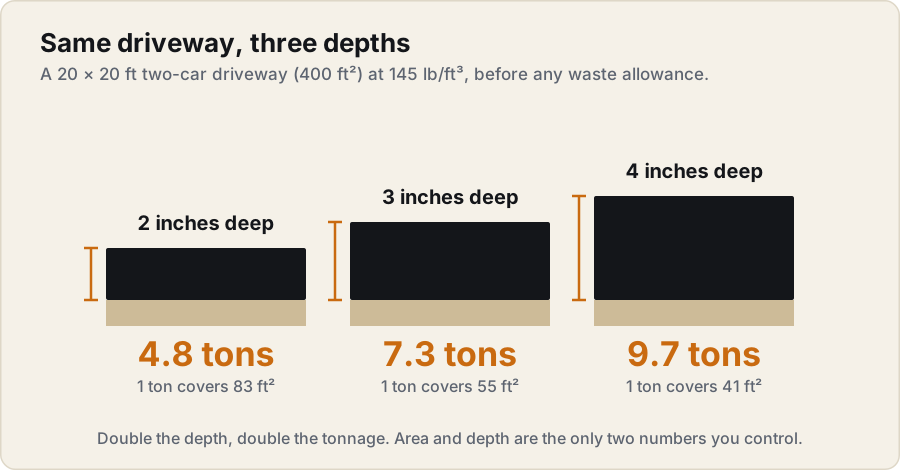
Tons needed by area and depth
Hot-mix asphalt at 145 lb/ft³, before any waste allowance.
| Area | 2 in deep | 3 in deep | 4 in deep |
|---|---|---|---|
| 200 ft² | 2.4 t | 3.6 t | 4.8 t |
| 400 ft² | 4.8 t | 7.3 t | 9.7 t |
| 600 ft² | 7.3 t | 10.9 t | 14.5 t |
| 800 ft² | 9.7 t | 14.5 t | 19.3 t |
| 1,000 ft² | 12.1 t | 18.1 t | 24.2 t |
| 1,500 ft² | 18.1 t | 27.2 t | 36.3 t |
| 2,000 ft² | 24.2 t | 36.3 t | 48.3 t |
How far does one ton go?
Coverage is just the calculation run backwards: 2,000 pounds divided by the weight of a square foot at your chosen depth.
| Depth | One ton covers |
|---|---|
| 1.5 in | 110 ft² |
| 2 in | 83 ft² |
| 2.5 in | 66 ft² |
| 3 in | 55 ft² |
| 4 in | 41 ft² |
What depth do you actually need?
| Use | Typical asphalt depth | Typical base depth |
|---|---|---|
| Residential driveway, cars only | 2–3 in compacted | 4–6 in compacted aggregate |
| Driveway with RV, boat or truck parking | 3–4 in compacted | 6–8 in compacted aggregate |
| Overlay on a sound existing surface | 1.5–2 in | Existing surface acts as base |
| Light commercial parking | 3–4 in, often in two lifts | 8 in or more, engineered |
These are common residential specifications, not an engineering standard. Soil type, drainage and frost depth all shift the right answer, and a local contractor will know what holds up in your area.
Show your math
Both tables on this page are calculated at build time from the same formula the calculator uses, so they cannot drift apart from the tool.
Density is 145 lb/ft³, the middle of the Asphalt Institute's published 142–148 lb/ft³ in-place range. At 800 ft² and 3 inches, the difference between the bottom and top of that range is about 0.3 tons.
Source: Asphalt Institute — pavement thickness and mix design FAQs
tons = area (ft²) × depth (in) ÷ 12 × 145 ÷ 2,000
coverage per ton = 2,000 ÷ (145 × depth ÷ 12)
Every figure in the tables above is generated from these two lines — nothing is typed in by hand.
Calculate your exact quantity
Before you order
- Add 5% for waste. Edges, uneven base and cooled material all cost you.
- Ask what a full truckload is. Ordering slightly over a load boundary can add a whole extra delivery.
- Confirm the mix. Surface course and binder course have different aggregate sizes and slightly different unit weights.
- Have the site ready. Hot mix arrives hot and has a working window measured in hours, not days.
Related
- Asphalt calculator — the tool on its own, if you just want the number.
- Asphalt tonnage calculator — the same tool with the coverage and driveway-size tables.
- How to calculate asphalt tonnage — the formula worked step by step.
- Asphalt driveway cost — turning tons into dollars.
- Asphalt millings calculator — if you are using recycled material.
Frequently asked questions
How much asphalt do I need for a 2-car driveway?
A typical two-car driveway of 20 × 20 feet (400 ft²) needs about 4.8 tons of hot-mix asphalt at 2 inches deep, or 7.3 tons at 3 inches, using a density of 145 lb/ft³. Add roughly 5% for waste, so order 5 tons or 7.6 tons respectively.
How much asphalt do I need for 1,000 square feet?
1,000 square feet needs about 12.1 tons at 2 inches deep, 18.1 tons at 3 inches, and 24.2 tons at 4 inches, based on 145 pounds per cubic foot. One ton covers about 83 square feet at 2 inches.
How much asphalt do I need to patch a pothole?
Measure the hole in inches, multiply length × width × depth, and divide by 1,728 to get cubic feet, then multiply by 145 and divide by 2,000 for tons. A 24 × 24 × 4 inch hole is 1.33 cubic feet, or about 193 pounds — under a tenth of a ton, which is why patches use bagged cold mix rather than a hot-mix delivery.
How many tons of asphalt are in a truckload?
A standard tandem dump truck typically carries in the region of 15 to 20 tons of hot mix, and a tri-axle more. Exact capacity depends on the truck and on local road weight limits, so ask your supplier what a full load is for them — ordering just over a load boundary can add a full second delivery charge.
Should I order by the ton or by the yard?
Hot-mix asphalt is almost always sold by the ton, because it is weighed at the plant on the way out. Aggregate base and asphalt millings are more often quoted by the cubic yard. If a supplier quotes yards for hot mix, multiply by about 1.96 to get tons at 145 lb/ft³.
How much asphalt do I need per square foot?
At the standard 2-inch driveway depth used throughout this page, one ton of asphalt covers about 80 square feet — so budget roughly 25 lbs (0.0125 tons) per square foot. That rate scales directly with depth: a 3-inch base needs about 37 lbs per square foot, and a 1.5-inch overlay needs about 19 lbs. Use the calculator above for your exact area and depth rather than the per-square-foot rule of thumb.
How much extra asphalt should I order for waste?
Most contractors add 5% to 10% on top of the calculated tonnage to cover compaction variance, truck-bed leftovers, and an uneven subgrade. For a driveway that calculates to 10 tons, that is an extra 0.5 to 1 ton. Round up to the next half-ton when you place the order, since plants sell by the ton, not by the pound.
How much asphalt do I need in metric tonnes?
The same formula works in metric: multiply your area in square meters by your depth in millimeters, divide by 1,000 to get cubic meters, then multiply by about 2.3 tonnes per cubic meter — the metric equivalent of the 145 lb/ft³ density used elsewhere on this page. A driveway that needs 10 US tons works out to about 9.1 metric tonnes.