T
Asphalt tonnage calculator
Tons of hot-mix asphalt for any rectangular area, with an adjustable density and an optional 5% waste allowance.
Enter your driveway size — get tons, cubic yards and cost instantly. Free, no sign-up.
Asphalt needed
15.23 tons
Estimated material cost: $1,523
Estimate only — confirm the final quantity with your paving contractor or asphalt supplier before ordering.
Asphalt & driveway calculators
Every result above traces back to a named formula and a published density assumption, so you can check it before you call a contractor — not just trust it.
Three calculators, each with its own formula shown on the page. Start with tonnage — it is the number your supplier actually needs.
Tons of hot-mix asphalt for any rectangular area, with an adjustable density and an optional 5% waste allowance.
Material cost from your own price per ton, plus the published installed-price ranges so you can sanity-check a quote.
Recycled asphalt sold by the ton but quoted by the yard — this one converts between the two and allows for compaction.
Length and width in feet. For an irregular driveway, split it into rectangles and add the results.
Most residential driveways use 2 to 3 inches of surface asphalt over a compacted gravel base.
Every result shows the formula and density used, so you can hand the number to a contractor and explain where it came from.
Want it worked by hand? How to calculate asphalt tonnage goes through it step by step, and how much asphalt do I need lists the tonnage for common driveway sizes. Deciding between surfaces first? Asphalt vs concrete.
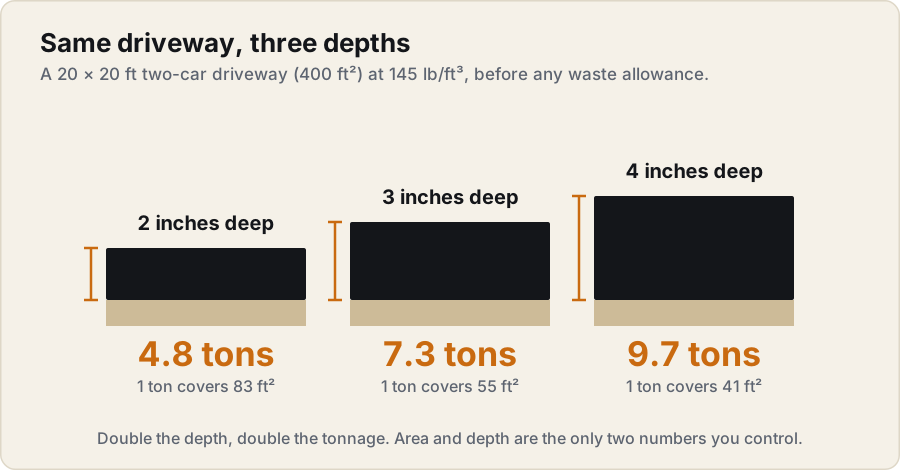
Depth is the number most people guess at, and it is the one that moves the total. Area is fixed by your driveway; depth is a choice, and it scales the tonnage in a straight line.
Show your math
Every tonnage number on this site comes from one formula: area × depth gives volume, and volume × density gives weight.
We use an in-place density of 145 pounds per cubic foot. The Asphalt Institute states that asphalt mixture typically weighs 142 to 148 pounds per cubic foot in place and recommends 148 for estimating — 145 sits in the middle of that published range, and every calculator lets you change it to match your supplier's mix.
Source: Asphalt Institute — pavement thickness and mix design FAQs
volume (ft³) = length (ft) × width (ft) × depth (in) ÷ 12
tons = volume (ft³) × 145 lb/ft³ ÷ 2,000
Worked example: 40 ft × 20 ft × 3 in = 200 ft³ × 145 ÷ 2,000 = 14.5 tons.
Multiply length by width to get the area in square feet, multiply that by the depth in inches divided by 12 to get cubic feet, then multiply by 145 lb/ft³ and divide by 2,000 to get tons. A 40 ft × 20 ft driveway at 3 inches deep needs about 14.5 tons of hot-mix asphalt before waste. Add roughly 5% for edges, compaction and waste.
One ton of hot-mix asphalt covers about 83 square feet at 2 inches deep, or about 55 square feet at 3 inches deep, using an in-place density of 145 pounds per cubic foot. Thicker layers cover proportionally less: at 4 inches, one ton covers roughly 41 square feet. Many supplier charts round the 2-inch figure down to 80 square feet as a safety margin.
Use 145 pounds per cubic foot unless your supplier gives you a different figure. The Asphalt Institute states that asphalt mixture typically weighs 142 to 148 pounds per cubic foot in place and recommends 148 for estimating. Pavetally defaults to 145 — the middle of that range — and lets you change it.
Yes. Every calculator on Pavetally is free, runs entirely in your browser, and does not require an account or an email address. Nothing you type into a calculator is sent to a server.
Last updated: August 14, 2026