How to calculate asphalt tonnage
To calculate asphalt tonnage, multiply length (ft) × width (ft) × depth (in) ÷ 12 to get cubic feet, multiply that by 145 lb/ft³, then divide by 2,000. For a 40 × 20 ft driveway at 3 inches: 800 × 0.25 = 200 ft³, then 200 × 145 ÷ 2,000 = 14.5 tons.
This is one of those calculations that looks harder than it is. There are only three moving parts: the area you are covering, how thick the asphalt will be, and how much a cubic foot of asphalt weighs. Get those three right and the arithmetic is trivial.
Step 1: Measure the area in square feet
Multiply length by width, both in feet. A 40-foot driveway that is 20 feet wide is 800 square feet. Measure the actual paved area, not the property line, and round up to the nearest half foot — asphalt is delivered in whole-ton increments anyway.
For an L-shaped or irregular driveway, split it into rectangles, calculate each one, and add the results. For a curved edge, measure the width at several points and use the average.
Step 2: Convert depth to feet
Depth is almost always specified in inches, but length and width are in feet, so the units have to match before you can multiply. Divide the depth in inches by 12.
- 2 inches ÷ 12 = 0.1667 ft
- 3 inches ÷ 12 = 0.25 ft
- 4 inches ÷ 12 = 0.3333 ft
Use the compacted depth — the finished thickness after rolling — not the loose depth the paver lays down.
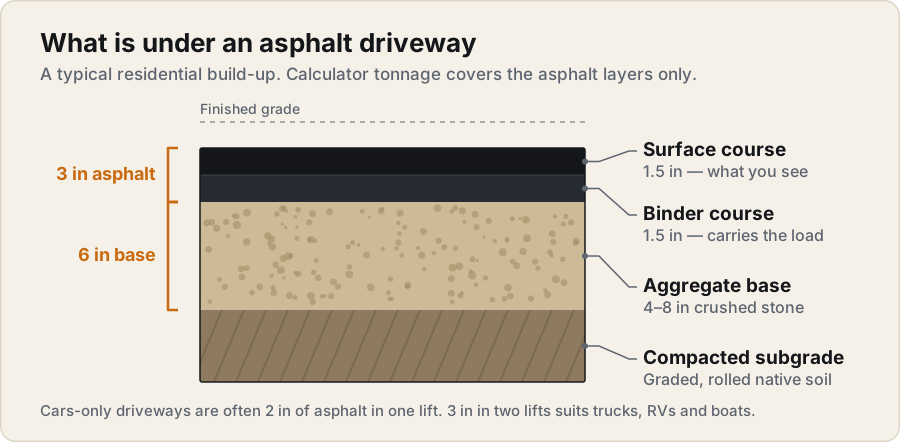
Depth here means the asphalt only. A quote that says "8 inches" usually means a few inches of asphalt sitting on several more inches of stone, and you do not pay for stone by the asphalt ton.
Step 3: Multiply to get cubic feet
Area × depth in feet = volume in cubic feet. For our example: 800 ft² × 0.25 ft = 200 cubic feet.
If you want cubic yards instead — which is how some suppliers quote — divide cubic feet by 27. 200 ÷ 27 = 7.4 cubic yards.
Step 4: Multiply by density and divide by 2,000
Asphalt weighs about 145 pounds per cubic foot in place. Multiply your cubic feet by 145 to get pounds, then divide by 2,000 to get US short tons.
200 ft³ × 145 lb/ft³ = 29,000 lb ÷ 2,000 = 14.5 tons.
Show your math
The whole calculation collapses into one constant if you always work in feet, inches and the standard density.
Asphalt weighs about 145 pounds per cubic foot in place — the Asphalt Institute gives a typical in-place range of 142 to 148 lb/ft³ and recommends 148 for estimating. Substitute your supplier's figure if they publish one.
Source: Asphalt Institute — pavement thickness and mix design FAQs
tons = L (ft) × W (ft) × D (in) ÷ 12 × 145 ÷ 2,000

shortcut:
tons ≈ L × W × D × 0.006042
Both forms give the same answer. The shortcut folds ÷12 × 145 ÷ 2,000 into a single constant.
Step 5: Add a waste allowance
Add about 5% to whatever the formula gives you. Material is lost at edges, the base is never perfectly level, and hot mix that cools before it is spread cannot be reused. On 14.5 tons that is 15.2 tons — call it 15 and a half.
Under-ordering is the expensive mistake here. Asphalt arrives hot and cannot be stored, so a short order means paying a second delivery charge for a fraction of a load.
The same driveway at three depths
40 ft × 20 ft, 145 lb/ft³, before waste:
| Depth | Volume | Tons | Tons + 5% waste |
|---|---|---|---|
| 2 in | 133.3 ft³ | 9.67 t | 10.15 t |
| 3 in | 200.0 ft³ | 14.50 t | 15.23 t |
| 4 in | 266.7 ft³ | 19.33 t | 20.30 t |
Doing it in metric
The logic is identical, only the constants change. Volume in cubic metres = length (m) × width (m) × depth (cm) ÷ 100. Asphalt at 145 lb/ft³ is about 2,323 kg/m³, so tonnes = volume (m³) × 2.323. The calculator has a metric toggle if you would rather not convert by hand.
Check your answer with the calculator
Run the same numbers through the calculator below. If your hand calculation and the calculator disagree, the usual culprit is depth left in inches without dividing by 12.
Related guides
- Asphalt calculator — run your dimensions through the tool.
- Asphalt tonnage calculator — tonnage by area, depth and density, with the coverage tables.
- How much asphalt do I need? — quantities by driveway size and depth.
- Asphalt driveway cost — what those tons actually cost installed.
Frequently asked questions
What is the formula for asphalt tonnage?
Tons = length (ft) × width (ft) × depth (in) ÷ 12 × density (lb/ft³) ÷ 2,000. With the standard 145 lb/ft³ in-place density, this simplifies to tons = length × width × depth × 0.006042. A 40 × 20 ft driveway at 3 inches works out to 14.5 tons.
Why divide the depth by 12?
Because length and width are in feet but depth is measured in inches, and every term in the volume calculation has to use the same unit. Dividing inches by 12 converts depth to feet, so length × width × depth gives cubic feet.
How do I convert cubic yards of asphalt to tons?
Multiply cubic yards by 1.96 at a density of 145 lb/ft³, because one cubic yard is 27 cubic feet and 27 × 145 = 3,915 pounds, or 1.96 tons. Many suppliers round this to 2 tons per cubic yard, which overestimates by about 2%.
Does the calculation change for a parking lot?
No — the formula is identical for any rectangular area. What changes is the specification: parking lots and commercial surfaces typically use thicker asphalt over a deeper base, and are often built in two layers (a binder course and a surface course), each of which you calculate separately and add together.
What density should I use if my supplier will not tell me?
Use 145 pounds per cubic foot. The Asphalt Institute states asphalt mixture typically weighs 142 to 148 lb/ft³ in place and recommends 148 for estimating, so 145 sits mid-range. The spread between 142 and 148 changes a 14.5-ton order by only about four-tenths of a ton, so it is not worth agonising over.