Asphalt Tonnage Calculator
How many tons of asphalt your job needs — by area, depth and density.
Asphalt needed
15.23 tons
Estimated material cost: $1,523
- Area 800 ft²
- Volume 7.41 yd³
- Metric 13.81 t
Estimate only — confirm the final quantity with your paving contractor or asphalt supplier before ordering.
To work out how many tons of asphalt you need, multiply length × width × depth (in inches ÷ 12) to get cubic feet, then multiply by 145 lb/ft³ and divide by 2,000. A 40 × 20 ft driveway at 3 inches needs 14.5 tons — the calculator above does it for your dimensions.
How to use this calculator
- Measure length and width in feet. Round up to the nearest half foot.
- Choose your depth in inches. This is the compacted thickness of the asphalt layer, not the gravel base.
- Leave the density at 145 lb/ft³ unless your supplier quotes a different figure for their mix.
- Keep the 5% waste allowance on for a real job. Turn it off if you only want the theoretical volume.
- Switch to the Material cost tab and enter your quoted price per ton to see what the asphalt itself will cost.
Show your math
This calculator converts your driveway dimensions into volume, then multiplies that volume by the weight of asphalt per cubic foot. Nothing is hidden and nothing is rounded before the final answer.
Asphalt weighs about 145 pounds per cubic foot in place. The Asphalt Institute puts the typical in-place range at 142 to 148 lb/ft³ and recommends 148 for estimating; 145 is the middle of that published range. If your supplier quotes a different unit weight, type it into the density field and every result updates.
Source: Asphalt Institute — pavement thickness and mix design FAQs
volume (ft³) = L (ft) × W (ft) × D (in) ÷ 12
tons = volume (ft³) × density ÷ 2,000

default density = 145 lb/ft³
Worked example: 40 × 20 × 3 in → 200 ft³ × 145 ÷ 2,000 = 14.5 tons (15.23 tons with 5% waste).
How much asphalt do common driveway sizes need?
Tons of hot-mix asphalt at 145 lb/ft³, before any waste allowance. Add about 5% for a real job.
| Driveway size | Area | 2 in | 3 in | 4 in |
|---|---|---|---|---|
| Single-car (10 × 20 ft) | 200 ft² | 2.4 t | 3.6 t | 4.8 t |
| Single-car, longer (12 × 24 ft) | 288 ft² | 3.5 t | 5.2 t | 7.0 t |
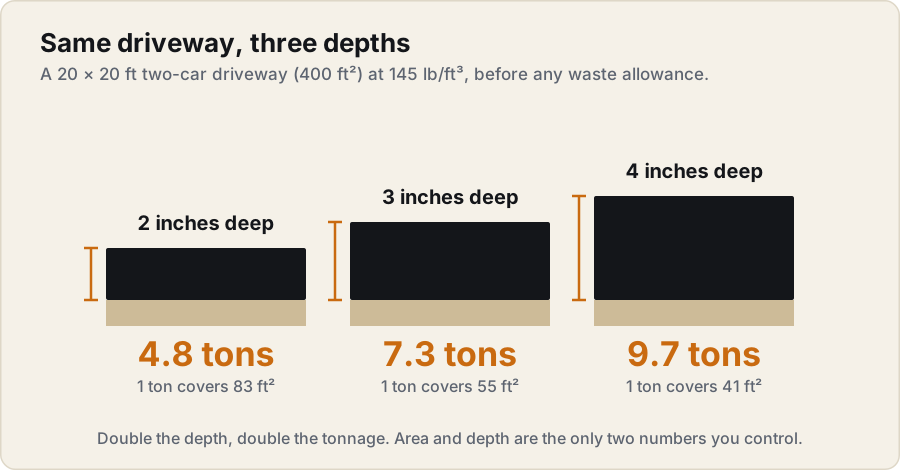
| Two-car (20 × 20 ft) | 400 ft² | 4.8 t | 7.3 t | 9.7 t |
| Two-car, longer (24 × 24 ft) | 576 ft² | 7.0 t | 10.4 t | 13.9 t |
| Long residential (20 × 40 ft) | 800 ft² | 9.7 t | 14.5 t | 19.3 t |
| Rural / long run (12 × 100 ft) | 1,200 ft² | 14.5 t | 21.8 t | 29.0 t |
How many square feet does a ton of asphalt cover?
One ton of hot-mix asphalt covers about 83 square feet at 2 inches deep. Coverage drops in direct proportion to thickness — double the depth and you halve the coverage.
| Compacted depth | Coverage per ton | Tons per 1,000 ft² |
|---|---|---|
| 1.5 in | 110 ft² | 9.1 t |
| 2 in | 83 ft² | 12.1 t |
| 2.5 in | 66 ft² | 15.1 t |
| 3 in | 55 ft² | 18.1 t |
| 4 in | 41 ft² | 24.2 t |
What depth should you use?
For a standard residential driveway, 2 to 3 inches of compacted asphalt over a properly compacted aggregate base is the usual specification. Go to 3 to 4 inches where heavy vehicles will park or turn, such as an RV pad or a shared drive used by delivery trucks.
One point worth checking with your contractor: quoted depth should be the compacted depth. Asphalt is laid loose and rolled, and it loses roughly a quarter of its loose thickness in compaction — so "3 inches laid" is not the same as "3 inches finished."
What to do with the number
- Price it — turn tons into a material cost and compare against published installed-price ranges.
- Check the math by hand — the same calculation, worked step by step.
- Look it up by driveway size — tons by area and depth, plus how far one ton goes.
- Still choosing a surface? Asphalt and concrete compared on cost, lifespan and climate.
- Costing millings instead? Recycled asphalt is sold by the ton but quoted by the yard, so it needs a different conversion.
Frequently asked questions
How do I calculate how many tons of asphalt I need?
Multiply length in feet by width in feet to get the area, multiply the area by the depth in inches divided by 12 to get cubic feet, then multiply by the density (145 lb/ft³) and divide by 2,000. For a 40 ft × 20 ft driveway at 3 inches: 800 ft² × 0.25 ft = 200 ft³, then 200 × 145 ÷ 2,000 = 14.5 tons.
Should I add extra for waste?
Yes — most estimators add about 5% to the calculated tonnage to cover edge loss, uneven base depth and material that cools before it can be spread. On a 14.5-ton job that is roughly three-quarters of a ton. Asphalt is delivered hot and cannot be stored, so ordering slightly short means a second delivery charge.
How thick should an asphalt driveway be?
A residential asphalt driveway is typically 2 to 3 inches of compacted surface asphalt over 4 to 8 inches of compacted aggregate base. Driveways that carry heavy vehicles, such as RVs or delivery trucks, are usually built with 3 to 4 inches of asphalt over a deeper base. Ask your contractor for the compacted depth, not the loose depth.
Does this calculator include the gravel base?
No. This calculator returns the tons of asphalt only. The compacted aggregate base underneath is a separate material with a different density and is usually quoted separately by the yard or ton.
What if my driveway is not a rectangle?
Split the shape into rectangles, run each one through the calculator, and add the tonnages together. For a curved edge, measure the average width across several points and use that as the width. For a circular area, area equals 3.14 × radius × radius, and you can enter that area as a single rectangle of equivalent size.
Is one cubic yard of asphalt two tons?
Close, but slightly high. At 145 pounds per cubic foot, one cubic yard (27 ft³) weighs 3,915 pounds, which is 1.96 tons. Rounding to 2 tons per cubic yard is a common shortcut and overestimates by about 2%, which is roughly the size of a normal waste allowance.